Third-Party Risk (TPRM)
TPRM assesses the security of organisations you depend on — suppliers, partners, service providers. The questions are the same as for your own systems, but you cannot scan a third party's infrastructure, so the evidence comes from them.
What makes it different
Three things shape how TPRM works:
- The vendor supplies the answers. You send a questionnaire; they respond with evidence. You are assessing their claims, not observing their systems.
- Vendors log in themselves. Vendor users get restricted access — they see only their own assessments and nothing else in your NxSAM.
- Effort should match exposure. A supplier handling customer data warrants far more scrutiny than one supplying stationery.
Pre-assessment: deciding how much scrutiny
Rather than sending every vendor the same long questionnaire, a short pre-assessment establishes what the relationship actually involves — what data they touch, what access they have, how critical they are.
That produces a tier, and the tier determines the depth of the full assessment. It keeps effort proportionate on both sides, and means a low-risk supplier is not asked to complete a two-hundred-question review.
The full assessment
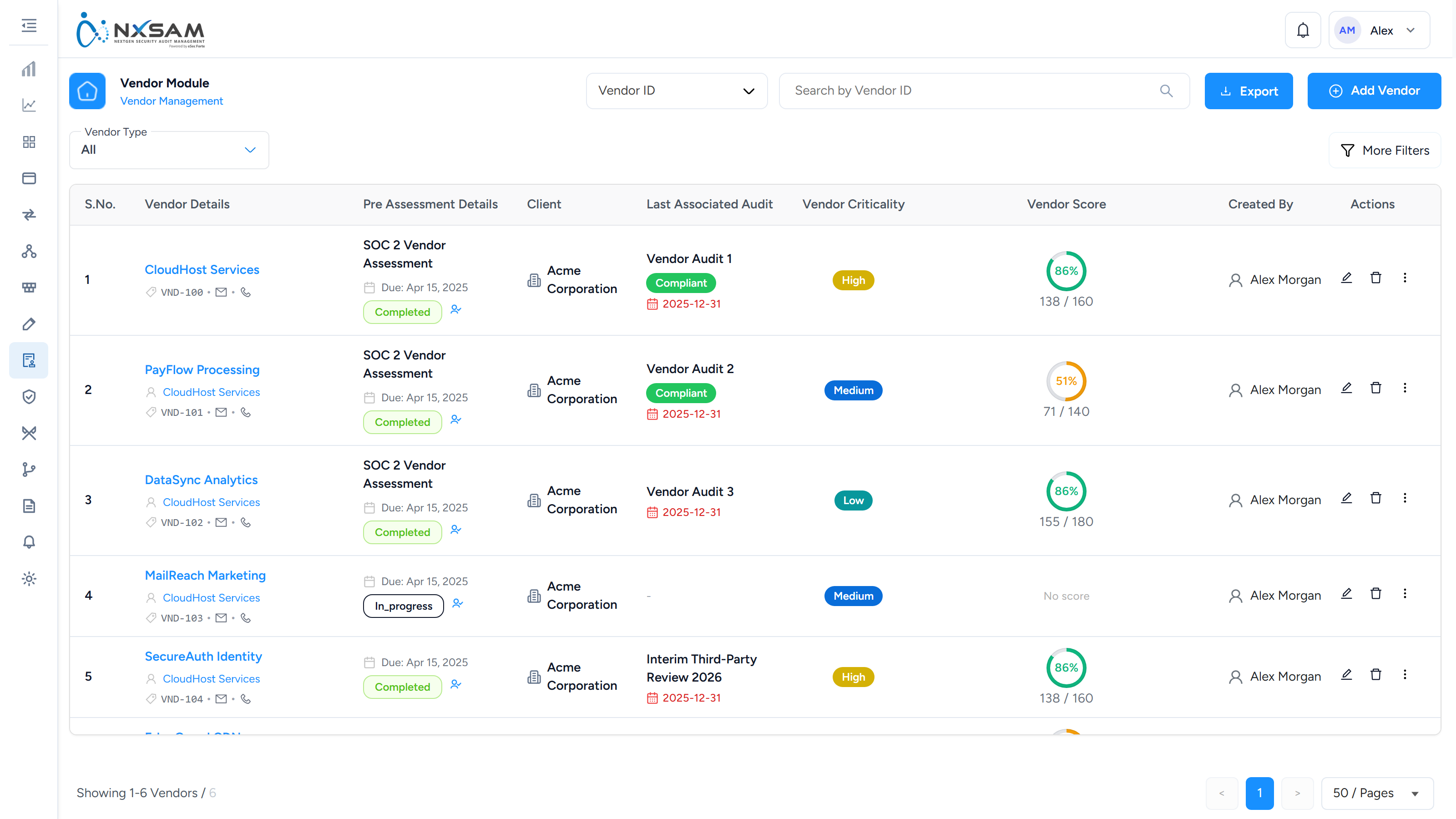
- Create the audit from a template appropriate to the vendor's tier.
- Invite the vendor. Their users receive access to their assessment only.
- The vendor responds, answering controls and attaching evidence.
- You review the responses — accepting, challenging, or asking for more.
- Findings are raised where responses are inadequate.
- Risks are recorded where gaps represent ongoing exposure.
Vendor users
Vendor users are external people with deliberately narrow access. They see their own assessments and nothing else — not your assets, not your findings, not other vendors.
Because they are external, their access needs managing as relationships change. A vendor user whose engagement has ended should be deactivated.
Reusing work across vendors
Vendors answering similar questionnaires give similar answers, and standards overlap heavily. TPRM includes support for identifying where a control in one framework matches a control in another, so an answer already given can be reused rather than re-collected.
This matters most when a vendor is assessed against several frameworks, or reassessed year after year — a great deal of what they told you last time remains true.
What good looks like
- Tier first, then assess. Pre-assessment before the full questionnaire keeps effort proportionate.
- Findings need owners on your side. A vendor gap is your exposure; someone internal has to decide what to do about it.
- Reassess on a cycle. A vendor assessed once three years ago is effectively unassessed.